

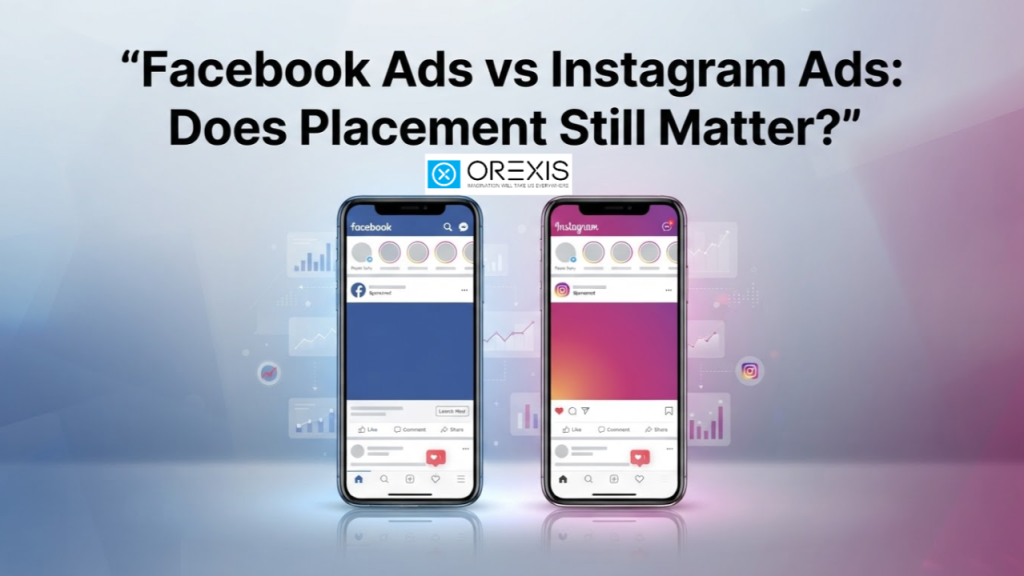
In today’s digital marketing landscape, running ads on Facebook and Instagram has become an essential strategy for businesses looking to reach the right audience, generate leads, and increase conversions. But one question continues to come up among marketers and business owners: Does ad placement still matter when running Meta Ads?
With Meta’s advanced AI-powered advertising system and Advantage+ placements, advertisers can reach potential customers across multiple platforms. However, choosing the right placement strategy can still influence campaign performance, engagement, and overall return on ad spend (ROAS).
Let’s explore the differences between Facebook Ads and Instagram Ads and understand how to make the most of each placement.
What Are Facebook Ads and Instagram Ads?
Facebook Ads and Instagram Ads are advertising solutions managed through Meta Ads Manager. They allow businesses to promote products, services, and offers to targeted audiences based on factors such as interests, demographics, behaviours, and online activity.
Although both platforms belong to Meta, users interact with content differently on each platform. Understanding these differences can help businesses develop more effective advertising strategies.
Facebook Ads vs Instagram Ads: Key Differences
1. Audience Behaviour
Facebook offers a wide range of content formats, including feeds, groups, Marketplace, videos, and Messenger. Users often interact with business pages, local communities, recommendations, and informative content.
Instagram focuses more heavily on visual storytelling through Reels, Stories, carousels, and feed posts. It is particularly useful for brands that can communicate their value through engaging visuals and short-form videos.
Marketing takeaway: Choose placements based on your target audience's behaviour rather than assumptions about age or platform popularity.
2. Ad Formats and Creative Strategy
The effectiveness of an ad depends partly on how well its creative matches the placement.
Facebook Ads work well with:
- Informative creatives and detailed offers.
- Lead generation campaigns.
- Local business promotions.
- Image, video, and carousel advertisements.
Instagram Ads work well with:
- Vertical videos and Reels.
- Visually appealing product showcases.
- Lifestyle content and demonstrations.
- Creator-style videos and Stories.
These are general creative considerations, not strict rules. Both platforms support multiple ad formats, and performance depends on the audience, offer, and campaign objective.
3. Lead Generation and Conversions
Both Facebook and Instagram can generate leads and sales. The better-performing placement depends on the type of business, campaign objective, creative quality, and conversion journey.
For example, a real estate business might generate enquiries through Facebook Feed ads, Instagram Reels, or both. A professional course provider could attract students through educational Instagram videos while also reaching interested parents and working professionals through Facebook.
Instead of assuming that one platform generates better leads, compare the quality of enquiries, conversion rates, and cost per qualified lead.
Does Ad Placement Still Matter in 2026?
Yes, but the approach has changed.
Meta's advertising system increasingly uses automation to distribute ads across eligible placements. Advantage+ placements can help advertisers reach audiences across Facebook, Instagram, Messenger, and the Audience Network, depending on campaign eligibility.
Rather than manually selecting every placement, advertisers can often allow Meta to allocate delivery based on its optimisation system.
However, automated delivery does not mean that every placement will perform equally well.
Placement still matters because:
- Creative compatibility: A vertical Reel may perform differently from a square image in the Facebook Feed.
- Audience behaviour: Users interact differently with Stories, Reels, and Feeds.
- Conversion quality: A placement that generates inexpensive clicks may not generate high-quality leads.
- Campaign objectives: Awareness, traffic, lead generation, and sales campaigns may require different creative approaches.
- User experience: Clear messaging and a suitable call to action can improve the experience across placements.
The goal is not simply to find the cheapest placement. It is to identify the placements that contribute to meaningful business results.
Advantage+ Placements vs Manual Placements
Meta Ads Manager provides advertisers with different ways to manage where their ads appear.
Advantage+ Placements
Advantage+ placements allow Meta to distribute ads across eligible placements using its delivery and optimisation system.
Benefits include:
- Access to a broader range of potential customers.
- More flexibility for automated delivery.
- Less manual placement management.
- Opportunities to improve campaign efficiency.
This is often a useful starting point for advertisers who want to test multiple placements without restricting delivery unnecessarily.
Manual Placements
Manual placements allow advertisers to select specific placements for their campaigns.
They can be useful when a campaign has a clear strategic requirement, a specific creative format, or reliable performance data showing that certain placements are unsuitable or consistently underperforming.
However, restricting placements too early can limit delivery opportunities and reduce the system's ability to find potential customers.
Best practice: Start with Advantage+ placements when appropriate, then make data-driven adjustments based on campaign performance.
How to Choose the Right Placement for Your Business
The right placement strategy depends on your business goals and audience.
For real estate businesses: Test Reels, Stories, and Feed placements using property walkthroughs, location highlights, and lead generation creatives.
For educational institutions: Use short videos, student testimonials, course information, and clear admission-focused calls to action.
For e-commerce brands: Test product demonstrations, carousel ads, lifestyle videos, and retargeting creatives.
For local service businesses: Test informative offers, customer testimonials, before-and-after visuals, and WhatsApp enquiry campaigns where available.
In every case, track what happens after someone clicks or submits a form. A high volume of enquiries does not necessarily translate into sales.
5 Tips to Improve Facebook and Instagram Ad Performance
1. Create Placement-Friendly Creatives
Prepare vertical creatives for Reels and Stories and suitable image or video formats for Feed placements. Keep important text and visuals within safe areas.
2. Test Different Creative Concepts
Experiment with testimonials, educational videos, offers, demonstrations, and problem-solution creatives to discover what resonates with your audience.
3. Track Meaningful Metrics
Monitor cost per lead, qualified lead rate, conversion rate, cost per acquisition, and ROAS where applicable. Avoid judging performance using clicks or engagement alone.
4. Give Campaigns Time to Optimise
Avoid making frequent changes based on limited data. Allow sufficient time and budget to collect meaningful results, while monitoring spend and lead quality.
5. Review Placement-Level Performance
Use Meta Ads Manager reports to understand how placements contribute to delivery and results. Compare performance in context, considering spend, conversion volume, audience size, and lead quality.
Common Placement Mistakes to Avoid
Even a well-designed campaign can underperform when advertisers make avoidable mistakes.
- Selecting placements based only on personal preference.
- Using the same creative without adapting it to different formats.
- Turning off placements after receiving only a small amount of data.
- Focusing on cost per click instead of business outcomes.
- Ignoring the quality of leads generated by each campaign.
- Making placement decisions without considering the overall campaign objective.
Remember, a low-cost lead is valuable only when it has a realistic chance of becoming a customer.
Final Thoughts: Does Placement Still Matter?
Facebook Ads vs Instagram Ads is no longer simply a choice between two platforms. In 2026, successful Meta advertising depends on combining the right creative, audience, campaign objective, placement strategy, and conversion process.
Automated placements can help advertisers reach potential customers efficiently, while placement-level analysis helps identify opportunities for improvement. The most effective strategy is to test, measure, and optimise based on actual business results.
At OREXIS Digital Marketing Agency, Calicut, we help businesses build performance-focused digital marketing strategies through Meta Ads, Google Ads, SEO, social media marketing, and content marketing.
About us
Orexis is one of the leading Digital marketing companies in Kozhikode, Kerala, that delivers Complete digital Marketing services like Social media promotions, SEO, PPC, Branding, etc. to their clients. Cost-effective online advertising services and customer satisfaction are our mottoes.
Subscribe to our newsletter!



Recent Posts
- Facebook Ads vs Instagram Ads: Does Placement Still Matter? October 10, 2026
- How Short-Form Videos Are Changing Brand Discovery September 24, 2026
- 2026 Digital Marketing Predictions: What Marketers Should Prepare for Now September 19, 2026
 Reach us on WhatsApp