

AI Overviews Are Changing Google Search: What Businesses Need to Do Now
- September 12, 2026
- Uncategorized
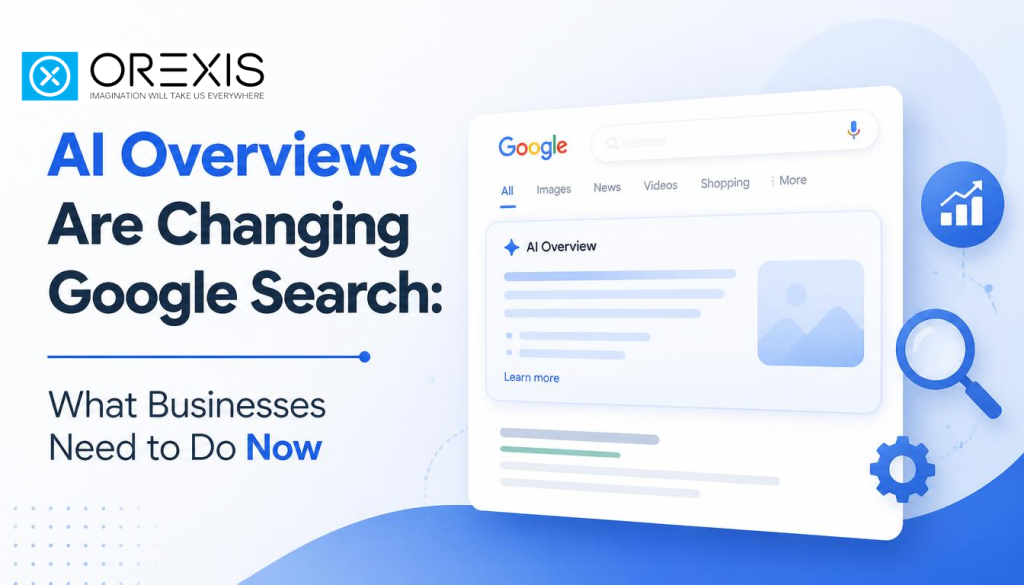
Google Search is changing faster than ever. With the rise of AI-powered search features such as AI Overviews, users can now get direct, AI-generated answers at the top of search results without needing to visit multiple websites.
For businesses, this represents a major shift in how customers discover brands, products, and services online.
Traditional SEO is no longer only about ranking in the top 10 blue links. Businesses now need to create content that search engines and AI systems can understand, trust, and potentially use when generating answers.
So, what does this mean for your business?
What Are Google AI Overviews?
Google AI Overviews are AI-generated summaries that appear within Google Search for certain queries. Instead of simply displaying a list of links, Google can provide users with a summarized answer and supporting sources.
For example, someone searching for:
“How can businesses generate leads online?”
may see an AI-generated overview explaining different lead-generation strategies, followed by links to relevant websites and resources.
This changes the traditional search journey. Users may get part of the information they need directly from the search results before deciding which websites to visit.
Why AI Overviews Matter for Businesses
Search behaviour is becoming more conversational and information-driven.
People are increasingly asking longer, more specific questions instead of searching for only short keywords.
For businesses, this means your online presence needs to answer real customer questions—not simply target keywords.
AI-powered search can influence:
- Brand visibility
- Organic traffic
- Website visits
- Customer discovery
- Search rankings
- Lead generation
- Brand authority
A business that consistently publishes useful, trustworthy content has a better opportunity to become part of the information ecosystem Google uses to answer users' questions.
Traditional SEO Is Not Dead
The rise of AI Overviews does not mean traditional SEO is no longer important.
Technical SEO, keyword research, backlinks, website performance, internal linking, and search intent still matter.
However, SEO is becoming broader.
Instead of focusing only on:
“How do I rank #1 for this keyword?”
businesses should also ask:
“How can I become a useful and trustworthy source for this topic?”
This shift requires a stronger focus on helpful content, expertise, relevance, and user experience.
Create Content That Answers Real Questions
One of the most important strategies businesses can adopt is creating content around questions customers actually ask.
Instead of publishing articles that simply repeat keywords, develop content that provides clear answers.
For example, a real estate company could create content such as:
- How much does it cost to buy an apartment in Calicut?
- What should first-time home buyers check before purchasing?
- Is buying an apartment better than renting?
- What are the benefits of investing in a property near a medical college?
Similarly, a digital marketing agency could publish:
- How does Google Ads generate leads?
- How much should a small business spend on Meta Ads?
- What is local SEO?
- How can businesses improve Google visibility?
This type of content aligns with conversational search behaviour.
Focus on Search Intent
Keywords alone are not enough.
Businesses need to understand why someone is searching.
A person searching for:
“digital marketing agency Calicut”
may be looking for a service provider.
Someone searching for:
“how does digital marketing work?”
is more likely looking for educational information.
Your content strategy should address different stages of the customer journey:
Informational Intent
The user wants to learn something.
Commercial Intent
The user is researching solutions or comparing options.
Transactional Intent
The user is ready to take action or make a purchase.
Creating content for each stage can help your brand build visibility throughout the search journey.
Build Topical Authority
Another important strategy is topical authority.
Rather than publishing one article about a subject and moving on, businesses should create a collection of useful content around the same topic.
For example, a solar company could build a content cluster covering:
- Benefits of rooftop solar
- Solar panel costs
- Solar subsidies
- On-grid vs hybrid solar systems
- Solar maintenance
- Solar battery storage
- Solar ROI
- Common solar installation questions
When multiple pieces of content comprehensively cover a topic, your website can demonstrate stronger relevance and expertise.
Make Your Content Easy for AI and Users to Understand
Good content should be easy for both people and search engines to understand.
Use:
- Clear headings
- Short paragraphs
- Descriptive subheadings
- Bullet points
- FAQs
- Simple explanations
- Relevant examples
- Structured information
Avoid unnecessarily complicated language or content written purely to increase keyword density.
The goal should be simple:
Answer the user's question clearly and completely.
Strengthen Your Brand Authority
AI-driven search makes brand credibility increasingly important.
Businesses should make it clear who is behind their content and why they are qualified to discuss a particular subject.
Consider including:
- Author information
- Company information
- Industry experience
- Case studies
- Customer testimonials
- Original research
- Expert opinions
- Relevant credentials
A strong online reputation can help establish your business as a credible source.
Don't Ignore Local SEO
For businesses serving specific locations, local SEO remains extremely important.
Make sure your business information is consistent across relevant online platforms and that your website clearly communicates:
- What you offer
- Where you operate
- Who you serve
- How customers can contact you
Create location-specific content where it genuinely helps users.
For example, a business targeting Calicut could create useful resources around “digital marketing in Calicut,” “SEO services in Calicut,” or other relevant local topics—provided the content offers genuine value rather than simply repeating the location name.
Use First-Hand Experience
AI can generate generic information quickly. That makes original experience even more valuable.
Businesses should publish content based on what they actually know and do.
Examples include:
- Case studies
- Campaign results
- Customer stories
- Before-and-after examples
- Expert interviews
- Industry insights
- Original surveys
- Project breakdowns
This gives your website something that generic AI-generated content cannot easily replicate: real-world experience.
Don't Depend Entirely on Organic Search
The changing search landscape is also a reminder that businesses should diversify their digital marketing strategy.
Alongside SEO, consider:
- Google Ads
- Meta Ads
- Social media marketing
- Email marketing
- YouTube
- Content marketing
- WhatsApp marketing
- Remarketing
The goal is to build multiple channels through which customers can discover and engage with your brand.
What Businesses Should Do Now
AI Overviews are part of a larger transformation in search.
Businesses should start adapting by taking these steps:
1. Audit existing content
Identify outdated, thin, duplicated, or low-value pages.
2. Understand customer questions
Talk to sales teams, customer service teams, and customers to discover what people actually want to know.
3. Build topic clusters
Create comprehensive content around your most important products, services, and industries.
4. Improve website experience
Make your website fast, mobile-friendly, easy to navigate, and technically sound.
5. Demonstrate expertise
Use case studies, author information, testimonials, and original insights.
6. Strengthen local visibility
Maintain accurate business information and create genuinely useful local content.
7. Track more than rankings
Monitor organic traffic, conversions, branded searches, engagement, and leads—not just keyword positions.
The Future of SEO Is About Being the Best Answer
Google Search is moving from a simple list of links toward a more conversational and AI-assisted experience.
That doesn't make SEO less important. It makes quality SEO more important.
Businesses that continue producing generic, keyword-stuffed content may struggle to stand out.
Businesses that understand their audience, answer genuine questions, demonstrate expertise, and provide useful information will be better positioned for the changing search landscape.
The future of SEO isn't simply about ranking for keywords.
It's about becoming a trusted source of information.
Final Thoughts
AI Overviews are changing how people interact with Google Search, and businesses need to adapt accordingly.
The best approach isn't to chase every new AI feature. Instead, focus on the fundamentals that have always mattered: helpful content, strong technical SEO, genuine expertise, user experience, and brand authority.
About us
Orexis is one of the leading Digital marketing companies in Kozhikode, Kerala, that delivers Complete digital Marketing services like Social media promotions, SEO, PPC, Branding, etc. to their clients. Cost-effective online advertising services and customer satisfaction are our mottoes.
Subscribe to our newsletter!


Recent Posts
- Facebook Ads vs Instagram Ads: Does Placement Still Matter? October 10, 2026
- How Short-Form Videos Are Changing Brand Discovery September 24, 2026
- 2026 Digital Marketing Predictions: What Marketers Should Prepare for Now September 19, 2026
 Reach us on WhatsApp