

2026 Digital Marketing Predictions: What Marketers Should Prepare for Now
- September 19, 2026
- Uncategorized
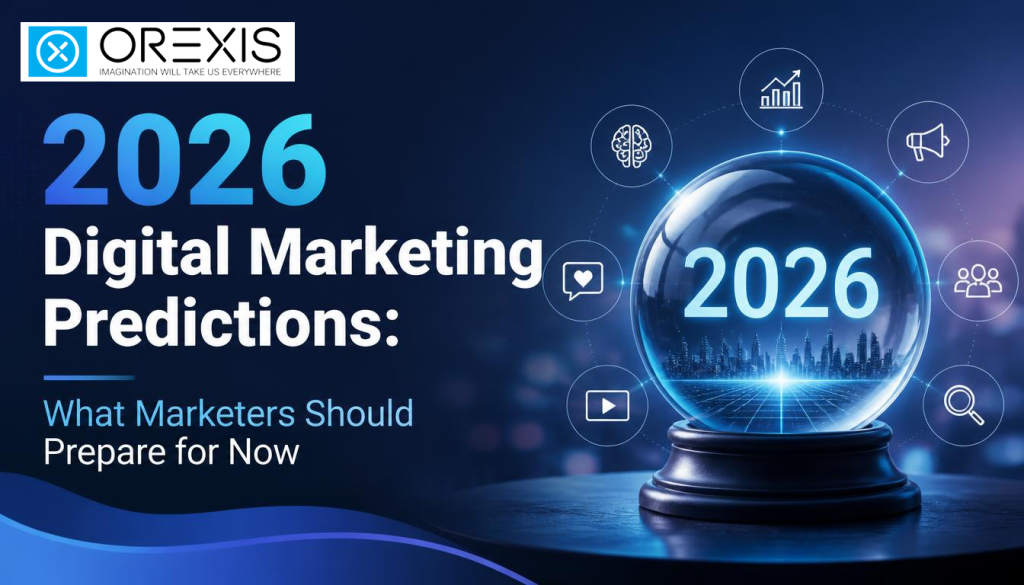
Digital marketing is entering a new phase. Artificial intelligence, changing search behaviour, automation, privacy, and increasingly personalized customer experiences are reshaping how businesses attract and convert customers.
For marketers, 2026 is not simply about adopting more tools. It is about understanding how technology is changing the customer journey and adapting marketing strategies accordingly.
Here are some of the major digital marketing trends marketers should prepare for in 2026.
1. AI Will Become Part of Everyday Marketing
AI is moving beyond content generation. Marketers are increasingly using AI for research, customer insights, campaign planning, creative development, personalization, automation, and performance analysis.
Instead of treating AI as a separate marketing tool, businesses will increasingly integrate AI into multiple stages of their marketing workflow.
What marketers should prepare for:
- Use AI for repetitive marketing tasks
- Automate reporting and data analysis
- Use AI to understand customer behaviour
- Combine AI efficiency with human creativity and strategy
- Develop clear processes for reviewing AI-generated content
The competitive advantage will not simply come from using AI. It will come from knowing where AI adds value and where human judgment remains important.
2. Search Will Move Beyond Traditional Google Results
Search is becoming more conversational and answer-focused. Users can increasingly find information through AI-powered search experiences instead of relying only on traditional blue-link results.
This means businesses need to think beyond ranking for individual keywords.
Content should answer real questions, demonstrate expertise, provide useful information, and clearly communicate what a business offers.
SEO is becoming more about visibility across search experiences.
Marketers should start thinking about:
- Search intent
- Brand mentions
- Topical authority
- Structured and useful content
- Local search visibility
- AI-generated answers and recommendations
The goal is no longer simply to rank. It is to become a useful and recognizable source of information.
3. GEO Will Become an Important Part of Search Strategy
Generative Engine Optimization, or GEO, focuses on improving a brand's visibility within AI-generated answers and generative search experiences.
Traditional SEO focuses heavily on search engine rankings. GEO considers how information about a brand may be understood, referenced, and presented by AI-powered systems.
For businesses, this means building strong digital authority across multiple channels.
A consistent brand presence, useful content, credible information, customer reviews, expert insights, and relevant online mentions can all contribute to a stronger digital footprint.
4. Search and Social Media Will Become More Connected
People are increasingly using social platforms to discover businesses, products, services, restaurants, destinations, and solutions.
Platforms such as Instagram, YouTube, TikTok, Facebook, and LinkedIn are not only places for publishing content. They are also discovery platforms.
This creates a new opportunity for marketers.
Content should be created with both engagement and discoverability in mind.
Businesses should pay attention to:
- Search-friendly captions
- Relevant keywords
- Clear video titles
- Strong hooks
- Educational content
- Customer-generated content
- Consistent brand messaging
5. Short-Form Video Will Continue to Drive Discovery
Short-form video will remain an important format for grabbing attention and introducing brands to new audiences.
However, simply creating more videos will not guarantee results.
The focus will increasingly shift toward content quality, relevance, storytelling, and conversion.
A successful business video should ideally answer at least one of these questions:
Does it educate?
Does it solve a problem?
Does it demonstrate a product or service?
Does it build trust?
Does it encourage action?
The strongest video strategies will connect content performance with actual business outcomes rather than focusing only on views.
6. AI Will Transform Paid Advertising
Advertising platforms are becoming increasingly automated, with AI playing a larger role in audience targeting, campaign optimization, creative testing, and delivery.
This means marketers may spend less time manually controlling every campaign setting and more time working on:
- Creative strategy
- Offer development
- Audience insights
- Conversion tracking
- Landing pages
- Lead quality
- Campaign analysis
In other words, the marketer's role is shifting from manual campaign management to strategic campaign management.
7. Creative Will Become a Major Competitive Advantage
As AI makes it easier to produce advertising variations, the volume of digital content will continue to increase.
That creates another challenge: attention.
When everyone can generate ads quickly, brands need stronger ideas to stand out.
Creative strategy will therefore become increasingly important.
Marketers should experiment with:
- Different hooks
- Multiple creative formats
- Customer testimonials
- Demonstration videos
- Educational content
- Problem-solution storytelling
- UGC-style content
The goal is not simply to create more content but to discover which messages genuinely connect with the target audience.
8. First-Party Data Will Become More Valuable
Businesses need reliable customer information to understand their audiences and personalize marketing.
First-party data collected directly through legitimate customer interactions can become increasingly valuable as marketers navigate changes in privacy, tracking, and advertising measurement.
Businesses should focus on building permission-based data relationships through:
- Websites
- Lead forms
- CRM systems
- Email marketing
- WhatsApp communication
- Customer accounts
- Loyalty programs
The future of marketing will depend not only on reaching people but also on building trusted relationships with them.
9. Lead Generation Will Shift Toward Lead Quality
Generating thousands of leads is not necessarily a sign of marketing success.
Businesses increasingly need to understand what happens after a lead is generated.
A better measurement approach considers:
Ad → Lead → Follow-up → Qualified Lead → Sales Opportunity → Customer
This means marketers should work closely with sales teams and track what happens beyond the initial form submission.
Metrics such as qualified leads, conversion rates, customer acquisition cost, and revenue can provide more meaningful insights than lead volume alone.
10. WhatsApp and Conversational Marketing Will Grow
Customers increasingly expect quick responses when they enquire about a product or service.
For many businesses, messaging platforms can become an important part of the conversion journey.
Marketing strategies can combine advertising with automated responses, qualification questions, follow-ups, and human sales conversations.
The objective is simple:
Make it easier for interested customers to move from enquiry to conversation to conversion.
11. Personalization Will Become More Important
Customers are exposed to huge amounts of content every day.
Generic marketing messages can easily get ignored.
AI and automation can help businesses personalize communication based on customer interests, behaviour, previous interactions, and stage in the buying journey.
However, personalization should provide genuine relevance rather than simply inserting a customer's name into a message.
12. Brand Trust Will Matter More
As AI-generated content becomes more common, customers may place greater value on signals of authenticity and credibility.
Brands can strengthen trust through:
- Real customer reviews
- Case studies
- Expert content
- Transparent communication
- Original research
- Behind-the-scenes content
- Consistent brand identity
- Demonstrable experience
Businesses that build recognizable and trustworthy brands can create value beyond individual campaigns.
13. Marketing and Sales Will Need to Work Together
Marketing cannot operate independently from sales.
A campaign may generate excellent traffic and leads, but if the sales process is slow or poorly managed, the business may not see the expected return.
In 2026, marketers should pay greater attention to the complete customer journey.
This means connecting:
Marketing + CRM + Sales + Customer Experience + Analytics
The more connected these systems become, the easier it is to understand which marketing activities contribute to business growth.
14. Data-Driven Decision Making Will Become Essential
Marketing decisions based purely on assumptions are becoming increasingly risky.
Businesses now have access to data from advertising platforms, websites, CRM systems, social media, search, and customer interactions.
The challenge is turning this data into useful decisions.
Marketers should regularly evaluate:
- Which channels generate qualified leads?
- Which creatives generate conversions?
- Which audiences produce valuable customers?
- Which landing pages perform better?
- Where are customers dropping off?
- How much does it cost to acquire a customer?
Data should not simply be collected. It should be used to improve marketing decisions.
15. The Biggest Shift: From Campaigns to Customer Journeys
Perhaps the biggest change marketers should prepare for is moving away from thinking about individual campaigns and toward understanding the complete customer journey.
A customer may discover a brand through a Reel, search for it on Google, read reviews, ask an AI assistant for information, visit the website, message the business on WhatsApp, and finally make a purchase.
That journey can involve multiple platforms.
Successful digital marketing strategies will therefore need to connect these touchpoints rather than treating each platform as a separate marketing activity.
How Businesses Can Prepare for 2026
Businesses do not need to adopt every new technology immediately.
Instead, start with the fundamentals:
1. Build a strong digital presence
Make sure your website, social profiles, Google presence, and brand information are accurate and consistent.
2. Create useful, original content
Focus on answering customer questions and demonstrating expertise rather than producing content simply for volume.
3. Start experimenting with AI
Identify repetitive tasks that can be automated while keeping human oversight for strategy, creativity, and important decisions.
4. Improve your measurement
Track business outcomes, not just impressions, clicks, and followers.
5. Strengthen your lead follow-up
A good marketing campaign can still fail if leads are not contacted and nurtured effectively.
6. Invest in your brand
Build credibility through reviews, customer experiences, useful content, and consistent communication.
Final Thoughts
Digital marketing in 2026 will be shaped by AI, evolving search behaviour, automation, personalization, social discovery, and changing customer expectations.
But technology alone will not create successful marketing.
The businesses that adapt effectively will be the ones that combine technology with strong strategy, useful content, creativity, data, and genuine customer understanding.
About us
Orexis is one of the leading Digital marketing companies in Kozhikode, Kerala, that delivers Complete digital Marketing services like Social media promotions, SEO, PPC, Branding, etc. to their clients. Cost-effective online advertising services and customer satisfaction are our mottoes.
Subscribe to our newsletter!



Recent Posts
- 2026 Digital Marketing Predictions: What Marketers Should Prepare for Now September 19, 2026
- AI Overviews Are Changing Google Search: What Businesses Need to Do Now September 12, 2026
- ChatGPT Ads Are Coming to India: A New Opportunity for Advertisers September 4, 2026
 Reach us on WhatsApp