

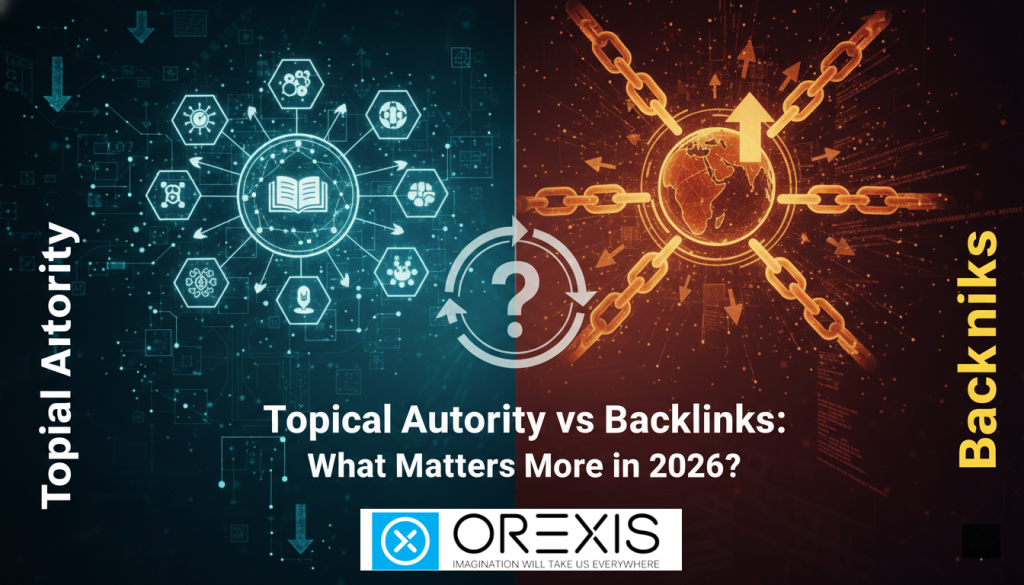
What is Topical Authority?
Topical authority refers to how deeply and comprehensively your website covers a specific subject.
Instead of publishing random content, you build content clusters around a niche, proving to search engines that you are an expert in that area.
Example:
If your niche is digital marketing, topical authority means covering:
- SEO basics
- Advanced SEO strategies
- Content marketing
- Paid ads
- Analytics
- Case studies
Key Benefits:
- Higher trust from search engines
- Better rankings for long-tail keywords
- Increased organic traffic consistency
- Improved user engagement
What Are Backlinks?
Backlinks are links from other websites pointing to your site. They have been a core ranking factor for years.
Think of backlinks as votes of confidence from other websites.
Types of Backlinks:
- High-authority backlinks (news sites, reputed blogs)
- Guest post links
- Directory links
- Social mentions
Key Benefits:
- Boost domain authority
- Faster ranking improvements
- Increased referral traffic
How SEO Has Changed by 2026
Search engines (especially AI-driven algorithms) now prioritize:
- Content relevance
- User intent
- Content depth
- Experience & expertise (E-E-A-T)
This shift has reduced the over-dependence on backlinks alone.
Topical Authority vs Backlinks: The Key Differences
| Factor | Topical Authority | Backlinks |
|---|---|---|
| Focus | Content depth & expertise | External validation |
| Long-term value | Very high | Medium |
| Sustainability | Strong | Can fluctuate |
| SEO impact (2026) | Dominant | Supportive |
| Risk factor | Low | High (spam links penalties) |
Why Topical Authority Matters More in 2026
1. Google Understands Context Better
Search engines now analyze topic coverage, not just keywords.
2. AI Search is Growing
AI-driven results favor comprehensive, expert-driven content.
3. User Experience is Priority
Websites that answer multiple related queries rank higher.
4. Reduced Link Manipulation
Backlink spam and paid links are easier for algorithms to detect.
Are Backlinks Still Important?
Yes—but their role has changed.
Backlinks are now:
- A trust signal, not the primary ranking factor
- More valuable when contextually relevant
- Stronger when coming from niche-specific sites
The Winning Strategy: Combine Both
Instead of choosing one, the smartest approach is to balance both.
Step 1: Build Topical Authority
- Create pillar pages
- Develop cluster content
- Cover every subtopic in your niche
Step 2: Earn Quality Backlinks
- Guest blogging
- Digital PR
- Create shareable content (guides, stats, infographics)
Real-World SEO Strategy for 2026
If you're a digital marketing agency, your structure should look like:
Pillar Page:
→ Complete Guide to Digital Marketing
Cluster Content:
→ SEO strategies
→ Social media marketing
→ Google Ads
→ Email marketing
→ Case studies
Then, build backlinks to:
- Pillar page
- High-performing blogs
Common Mistakes to Avoid
- Focusing only on backlinks
- Publishing shallow, low-value content
- Ignoring internal linking
- Buying spammy backlinks
- Not updating old content
Final Verdict: What Matters More?
Topical Authority is the clear winner in 2026.
Backlinks still matter—but as a supporting factor.
If you want long-term SEO success:
- Build deep, valuable content
- Then amplify it with quality backlinks
Conclusion
SEO in 2026 is no longer about shortcuts. It’s about expertise, depth, and trust.
Websites that focus on educating users and covering topics thoroughly will dominate search rankings—while backlinks will act as a credibility booster, not the main driver.
About us
Orexis is one of the leading Digital marketing companies in Kozhikode, Kerala, that delivers Complete digital Marketing services like Social media promotions, SEO, PPC, Branding, etc. to their clients. Cost-effective online advertising services and customer satisfaction are our mottoes.
Subscribe to our newsletter!

Recent Posts
- Topical Authority vs Backlinks: What Matters More in 2026? April 11, 2026
- High-Converting Landing Page Trends in 2026 March 24, 2026
- How AI Improves Lead Scoring and Customer Targeting in 2026 March 17, 2026
 Reach us on WhatsApp